
How the 50% limit on business meals and entertainment works, the cases where the Canada Revenue Agency lets you claim the full cost, client meals versus staff events, travel and conventions, the GST/HST on meals, and the records to keep, with every rule linked to the CRA.
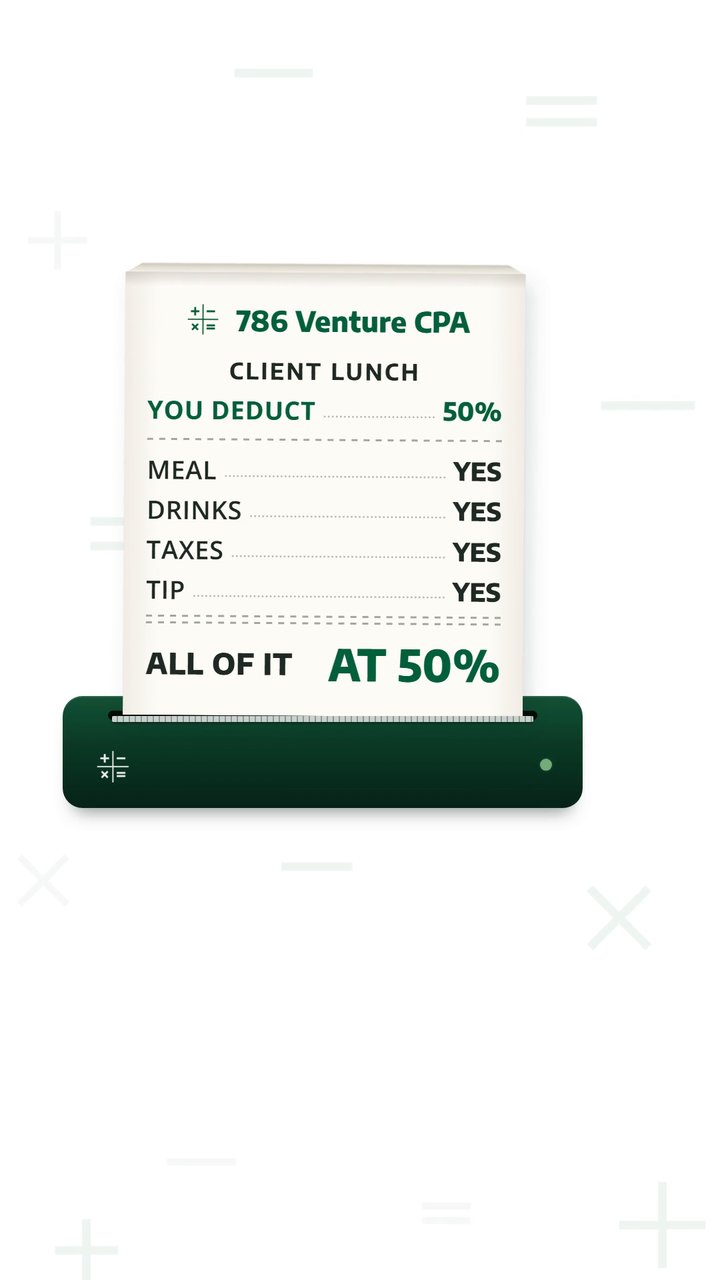
You can usually deduct 50% of what you spend on food, drinks and entertainment for your business, worked out on the actual cost or a reasonable amount, whichever is less. Taxes and tips are part of the cost, and the same 50% applies to the GST/HST you claim back on those costs. The full cost is deductible when you bill the meal to a client and show it on the invoice, for up to six office parties or similar events a year to which all employees at a location are invited, for meals included in an employee’s income or provided at a remote work location or a construction work camp, and for a charity fundraising event. Long-haul truck drivers can deduct 80%. Sole proprietors claim the allowable part on line 8523 of Form T2125, and a corporation adds back the part it cannot deduct on Schedule 1 of its T2 return.
What Is the 50% Rule for Meals and Entertainment?
The CRA’s page for line 8523, meals and entertainment says the most you can claim for food, beverages and entertainment is 50% of the lesser of the amount you incurred and an amount that is reasonable in the circumstances. The meal still has to be for your business: the CRA’s bulletin on food, beverages and entertainment expenses (IT-518R, now archived) says you must be able to show the amount was spent to earn income, and personal meals are not deductible.
The same bulletin says the 50% applies to the related taxes and tips, and to a restaurant gift certificate. The limit also applies when you travel or go to a convention, conference or similar event.
- The CRA’s list: tickets and entrance fees to an entertainment or sporting event, gratuities, cover charges, and room rentals such as hospitality suites.
- IT-518R adds: private boxes at sports facilities, a cruise, admission to a fashion show, and entertaining guests at night clubs, athletic, social and sporting clubs.
- Club dues are different: Guide T4002 says you cannot deduct membership dues, including initiation fees, for a club whose main purpose is dining, recreation or sporting activities.
When Can You Claim More Than 50%?
The line 8523 page and Guide T4002 list the cases where the 50% limit does not apply. This table puts them next to the common 50% cases:
| Meal or event | What you can deduct |
|---|---|
| A meal or drinks with a client or prospect | 50% |
| Tickets to a game, concert or show for a client | 50% |
| Your meals while travelling for business | 50% |
| A convention fee that includes meals not shown separately | $50 a day is treated as meals, at 50%; the rest of the fee in full |
| A meal you bill to a client and show on the bill | 100% |
| An office party or similar event for all employees at a location | 100%, up to six events a year |
| Meals included in an employee’s income, or at a remote or special work location | 100% |
| Meals for employees housed at a temporary construction work camp | 100% |
| A fundraising event mainly for a registered charity | 100% |
| Food and drinks your business sells, as a restaurant, hotel or motel | 100% |
| A long-haul truck driver’s food and drinks on an eligible trip | 80% |
| Club membership dues (dining, recreation or sports clubs) | Not deductible |
For the remote location case, the CRA says the amount cannot be for a conference, convention or seminar, and the special work location must be at least 30 kilometres from the closest urban centre with a population of 40,000 or more. For the truck driver rate, an eligible trip is at least 24 continuous hours away from home driving a long-haul truck that carries goods to or from a place at least 160 kilometres away. IT-518R also says meals included in an airplane, train or bus fare are not treated as meals, so the 50% limit does not apply to them, but it does apply on a ship, boat or ferry.

Our packages
Not sure where to start?
- Led by a licensed CPA
- Fixed fees quoted up front
- Bookkeeping, tax and payroll
- Sign up online in minutes
Client Meals vs Staff Meals: What Is the Difference?
Client meals are 50%. Taking a client, a prospect or a supplier out is the standard case. The exception is a meal you are paid back for: IT-518R says that if you bill a reasonable meal cost to a client and identify it in writing on the bill, you deduct it in full, and the 50% limit applies to the client instead.
Staff events can be 100%. The CRA says the limit does not apply to an office party or similar event when you invite all your employees from a particular location, up to six events a year. IT-518R adds that the event can be held at a restaurant or a rented hall, that spouses and children can be included if all employees’ families are invited, and that an event only for selected employees or for the owners, partners or shareholders stays at 50%. Allowances you pay employees to buy their own meals do not qualify.
Your staff’s side. The CRA’s page on social events and hospitality functions says an in-person party is not a taxable benefit to your employees if it is available to all employees, costs $150 or less a person including taxes (spouses count as persons, and taxis home or hotel rooms are not counted), and is within six employer-paid social events a year. If the cost goes over $150 a person, the full amount is taxable. A meal at a work event such as a planning or education session is not taxable if it has a reasonable cost and is not a thank-you for a job well done.
Lunch with a client or prospect
- 50% of the cost, taxes and tips included
- 100% only if you bill it to the client and show it on the bill
- Keep who you met, where, when and why
A party for all your employees
- 100% for the business, up to six events a year
- Every employee at that location is invited
- Not taxable to staff at $150 or less a person
Dinner for the owners or a few staff
- 50%, because it is not open to all employees
- The same for a lunch with only a few of your staff
- A personal meal is not deductible at all
How Do Travel Meals and Conventions Work?
Travel meals are 50%. Guide T4002 says travel expenses, including meals, go on line 9200 of Form T2125, and in most cases the 50% limit applies to the meals, drinks and entertainment. Keep the receipts. Our business travel expenses guide covers the rest of a trip, such as fares, hotels and trips that mix business with a holiday. For the car itself, see our guide to vehicle expenses and the CRA logbook.
The $23 flat rate is not for business meals. The CRA’s meal and vehicle rates page lets you use a simplified method of $23 a meal, up to $69 a day, without receipts, for the 2025 tax year. That page is for moving expenses, the northern residents deductions and medical travel. The CRA’s business pages offer a $23 daily flat rate only to self-employed foot and bicycle couriers and rickshaw drivers, for the extra food their work needs, with a log of the days and hours worked.
Conventions. The CRA’s convention expenses page says you can deduct the cost of up to two conventions a year that relate to your business and are held by a business or professional organization. If the fee includes food or entertainment that the organizer does not show separately, $50 a day of the fee is treated as meals and entertainment at 50%. Coffee and doughnuts at meetings or receptions do not count as meals.
- Cathy paid $600 for a two-day convention. The organizer did not say what part was for food and entertainment.
- Convention expense: $600 minus $50 for each of the 2 days = $500, claimed in full.
- Meals: $50 × 2 days = $100, claimed at 50% = $50.
Total deduction: $550. The amounts are the CRA’s; the total is our sum of them.
Can You Claim the GST/HST on Business Meals?
Yes, at the same 50%. The CRA’s Guide RC4022 says a GST/HST registrant can claim input tax credits (ITCs) for the GST/HST paid on reasonable meal and entertainment expenses that relate to its commercial activities, and when the income tax deduction is limited to 50%, the ITC is limited to 50% too. The CRA’s page on methods to calculate ITCs gives two ways to do it:
- Claim 50% as you go. Claim half of the GST/HST paid on these costs in each return, with no adjustment at year end.
- Claim 100% and adjust once. Claim the full GST/HST during the year, then add back 50% of it. Monthly and quarterly filers add it in the first return of the next fiscal year; annual filers add it in that year’s return. For long-haul truck drivers the adjustment is 20%.
The 50% also applies to the GST/HST in meal costs you reimburse to employees and partners. If you use the GST/HST quick method, you do not claim ITCs on meals or other operating expenses at all, because the quick method rates already take them into account.
Sole Proprietor or Corporation: Where Does the Claim Go?
Sole proprietors claim the allowable part of meals and entertainment on line 8523 of Form T2125, with their personal return. The CRA’s line 8523 page says you work out the allowable part for business use yourself, so the amount on the line is already the 50% (or the full amount for an exception).
Corporations follow the same rule. The CRA’s T2 Corporation Income Tax Guide says the deductible part of food, beverages and entertainment is only 50% of the lesser of the actual cost and a reasonable amount, with 80% for long-haul truck drivers and a full deduction for meals at a temporary construction work camp. The corporation’s financial statements show the full cost, and Schedule 1 of the T2 return adds back the part that is not allowed for tax.
The owner’s own meals. A meal is a business expense only when it is for the business. Your everyday lunches are personal whether you are a sole proprietor or the corporation pays, and a party only for the owners does not get the all-employees exception.
What Records Should You Keep?
IT-518R says you should be ready to show that each meal or entertainment cost was for earning income, and keep a record of the names and business addresses of the people you entertained, with the place, date, time and amount, backed by receipts. Records are normally kept for six years from the end of the tax year they relate to. See how long to keep business records.
- Receipts: the itemized bill and the card slip, with taxes and the tip.
- Who and why: the names and businesses of the people you met, and the business purpose.
- Billed meals: the invoice that shows the meal charged to your client.
- Staff events: the invitation to all employees at the location, the guest count and the cost a person, and a count of events in the year.
- Conventions: the fee, the program and the days with meals.
- GST/HST: the GST/HST on each receipt and the method you use for the 50%.
How Can We Help With Meals and Entertainment?
For sole proprietors, we prepare your personal return with the business statement (Form T2125), including the meals and entertainment line at the allowable part and your travel and convention costs. For incorporated owners, we record meals in your books with the right GST/HST input tax credit, keep staff events and billed meals that can be claimed in full apart from client meals, and make the add-back in the corporation’s T2 return. Fees are fixed and quoted up front.
If you want your meals and entertainment set up the right way before your year end, see our packages.
Frequently Asked Questions
Can I deduct the full cost of a client lunch?
Usually not. A client meal is deductible at 50% of the cost, including taxes and tips. You can deduct the full cost only if you bill the meal to the client and show it on the bill, and then the 50% limit applies to the client instead.
Is our staff holiday party 100% deductible?
Yes, if you invite all your employees at that location, for up to six such events a year. A party only for the owners or selected staff stays at 50%. For your employees, the party is not a taxable benefit if it costs $150 or less a person, including taxes.
Can I use the $23 a meal flat rate for business travel?
No. The simplified meal rate from the CRA, $23 a meal and up to $69 a day for 2025, is for moving expenses, the northern residents deductions and medical travel. For business travel, keep your receipts and claim 50% of the meals. The only business flat rate is $23 a day for self-employed foot and bicycle couriers and rickshaw drivers.
Can I claim all the GST/HST on a business meal?
No, the input tax credit is limited to 50% as well. You can claim 50% of the GST/HST in each return, or claim 100% during the year and add back 50% once a year. Quick method filers do not claim input tax credits on meals.
Does the 50% rule apply to my corporation too?
Yes. A corporation can deduct only 50% of the lesser of the actual cost and a reasonable amount, with the same exceptions. The full cost stays in the financial statements, and Schedule 1 of the T2 return adds back the part that is not allowed. Personal meals are not deductible either way.
Reviewed on 31 October 2026. The meals and entertainment limits, exceptions, rates, GST/HST rules and examples in this article are from the Canada Revenue Agency, linked beside each fact and listed below.
T1 Personal Tax
Personal tax returns, including the business statement and meals claim for self-employed Canadians
T2 Corporate Tax
Corporate tax returns for Canadian corporations, with proactive tax planning and the meals add-back handled the right way
Sources
- Canada Revenue Agency, Line 8523, Meals and entertainment (page dated 2026-08-31, checked 31 October 2026)
- Canada Revenue Agency, Guide T4002, Chapter 3, Expenses (page dated 2026-04-16, checked 31 October 2026)
- Canada Revenue Agency, Convention expenses (page dated 2026-08-31, checked 31 October 2026)
- Canada Revenue Agency, Interpretation Bulletin IT-518R, Food, Beverages and Entertainment Expenses (archived) (page dated 2017-06-22, checked 31 October 2026)
- Canada Revenue Agency, Meal and vehicle rates used to calculate travel expenses (page dated 2026-01-20, checked 31 October 2026)
- Canada Revenue Agency, Social events and hospitality functions (page dated 2025-08-27, checked 31 October 2026)
- Canada Revenue Agency, Guide RC4022, General Information for GST/HST Registrants (page dated 2026-01-07, checked 31 October 2026)
- Canada Revenue Agency, Calculate input tax credits, Methods to calculate the ITCs (page dated 2025-06-16, checked 31 October 2026)
- Canada Revenue Agency, T2 Corporation Income Tax Guide, Chapter 3 (page dated 2026-05-28, checked 31 October 2026)


