

What a small business owner in Canada can claim for a business trip, and what they cannot: fares and hotels, meals on the road and the $23 flat rate, trips that mix business and a holiday, conferences, travel outside Canada, bringing your family, a corporation paying for the owner’s trip, the GST/HST and the records to keep, with every rule linked to the Canada Revenue Agency.
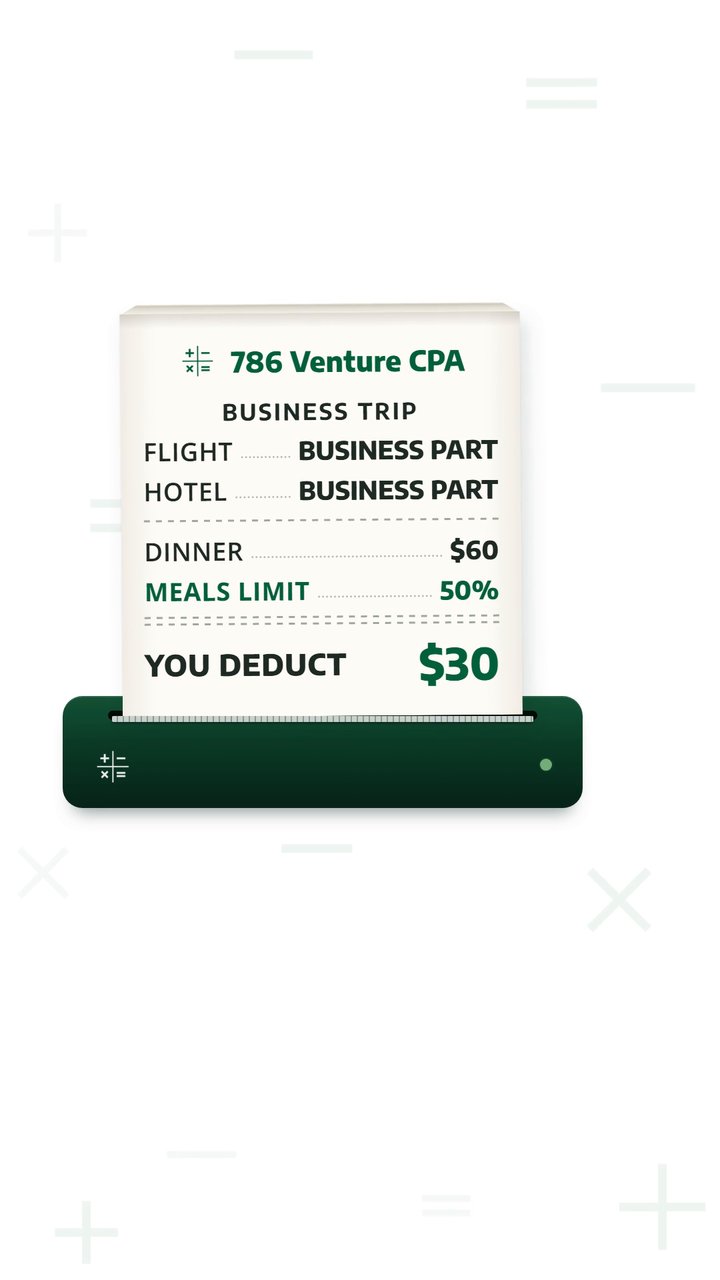
You can deduct reasonable travel costs you pay to earn business income: fares, hotels and meals, but only the business part. Meals while you travel are limited to 50%, and the CRA’s $23 a meal flat rate is not for business trips, so keep your receipts. Holiday days you add to a trip and the costs of family members who come along for personal reasons are personal, so they are not deductible. You can deduct up to two conventions a year. If your corporation pays, a reasonable reimbursement of business trip costs backed by receipts is not taxable to you, but a trip that is mainly personal is a taxable benefit. GST/HST registrants claim input tax credits on the business part, at 50% for meals.
What Travel Expenses Can You Deduct?
The CRA’s page for line 9200 of Form T2125 says you can deduct travel expenses you incur to earn business and professional income. It lists three kinds:
- Public transportation fares, such as flights, trains and buses.
- Hotel accommodations.
- Meals, where in most cases the 50% limit applies. It also applies to food, drinks and entertainment on a plane, train or bus when the ticket price does not include them.
Two rules from Guide T4002 sit on top of that. You can deduct a reasonable expense you incur to earn income, and since you cannot deduct personal expenses, you enter only the business part of an expense. Those two words, reasonable and business, decide most travel questions.
Car costs are not on the travel line. A vehicle you drive for business trips is claimed as motor vehicle expenses, with a logbook of your business kilometres. See our guide to vehicle expenses and the CRA logbook.
Travel Costs at a Glance
This table puts the CRA’s rules for a self-employed person side by side. The GST/HST row applies only if you are registered for the GST/HST.
| Cost | What a sole proprietor can claim |
|---|---|
| Flights, trains and buses for a business trip | The business part, if reasonable |
| Hotel for the nights you are away on business | The business nights |
| Your meals while travelling on business | 50%, with receipts |
| Food and drinks on a plane, train or bus not included in the ticket | 50% |
| The $23 a meal flat rate | Not for business trips |
| Convention fees, up to two conventions a year | In full, less $50 a day for meals not shown separately |
| The $50 a day meal part of a convention fee | 50% |
| Holiday days you add to a business trip | Not deductible |
| Travel costs of a family member who comes along for personal reasons | Not deductible |
| GST/HST on travel costs (registrants) | Input tax credit for the business part, 50% for meals |
The table is for sole proprietors filing Form T2125. A corporation deducts its own travel costs on the same 50% meal rule, and what changes for an owner whose corporation pays is covered further down.

Our packages
Not sure where to start?
- Led by a licensed CPA
- Fixed fees quoted up front
- Bookkeeping, tax and payroll
- Sign up online in minutes
How Do Meals Work When You Travel?
The CRA’s page on line 8523, meals and entertainment says the most you can claim for food, beverages and entertainment is 50% of the lesser of what you spent and an amount that is reasonable in the circumstances, and that the same limit applies to your meals when you travel or go to a convention, conference or similar event. So a $60 dinner on a business trip gives you a $30 deduction. Keep the receipt.
Long-haul truck drivers are the one travel exception on that page: their food and drinks during an eligible travel period of at least 24 hours away from home are deductible at 80%. For client meals, staff events and the other exceptions, see our guide to meals and entertainment and the 50% rule.
The CRA’s meal and vehicle rates page lets you claim a flat $23 a meal, up to $69 a day, without receipts, for the 2025 tax year. That simplified method is for moving expenses, the northern residents deductions and medical travel, not for a business trip. On the business side, the CRA offers a $23 daily flat rate only to self-employed foot and bicycle couriers and rickshaw drivers. For your own business travel, claim the actual meals at 50%, with receipts.
What If You Mix Business and a Holiday?
The CRA’s business pages do not give a formula for a trip that is part business and part holiday. The rule that applies is the general one: only the business part is deductible, and personal costs are not.
The closest CRA test is the one for employees on its payroll page on travel expenses. An employer’s payment for a business trip is not taxable when the costs are reasonable, the trip’s main purpose is the business, and the employee spends more than 50% of the time on business. When the employee extends the trip, only the part related to the extension is taxable.
What we suggest to our clients, as a practical reading of those rules: when the main purpose of the trip is business and most of the days are business days, claim the fares and the hotel and meals for the business days. Holiday days, side trips and sightseeing are personal. When the trip is mainly a holiday with a meeting added, claim only the costs the meeting itself caused.
A trip only for work
- Fares and hotel: the business cost
- Meals: 50%
- Keep a note of who you met and why
Extra days added on
- Fares: business, when work is the main purpose
- Hotel and meals for the business days only
- Holiday days: personal
One meeting on a vacation
- Fares and hotel: personal
- Only the costs the meeting itself caused
- Expect questions on any larger claim
- You fly to Vancouver for a three-day trade conference and stay two extra days for a holiday.
- Return flight: $500. The trip is mainly for the conference, so the flight is a business cost.
- Hotel at $220 a night: the 3 conference nights, $660, are business. The 2 holiday nights, $440, are personal.
- Meals at $70 a day for the 3 conference days: $210 × 50% = $105.
- Travel claim: $500 + $660 + $105 = $1,265, plus the conference fee.
The numbers are our example; the rules are the CRA’s.
Can You Deduct Conferences and Conventions?
Yes, up to two a year. The CRA’s convention expenses page says you can deduct the cost of attending up to two conventions a year, and each one has to:
- relate to your business or your professional activity, and
- be held by a business or professional organization within the geographical area where the organization normally conducts its business.
If the fee includes food, drinks or entertainment that the organizer does not show separately, you subtract $50 from the fee for each day it provides them, and claim that $50 a day as meals at 50%. Coffee and doughnuts at meetings or receptions do not count. The fee goes on line 9270, other expenses; your flight, hotel and meals to attend are travel costs under the rules above.
- Cathy paid $600 for a two-day convention. The organizer did not say what part was for food and entertainment.
- Convention expense: $600 minus $50 for each of the 2 days = $500.
- Meals: $50 × 2 days = $100, claimed at 50% = $50.
Can You Deduct Business Travel Outside Canada?
Yes. The CRA’s travel rules do not stop at the border: the trip still has to be for your business, the costs reasonable, and only the business part is deductible. Meals are still limited to 50%.
Conventions abroad. The convention page says the geographical limit may not apply if an organization from another country sponsors the convention and it relates to your business or professional activity.
Sales tax abroad. An input tax credit, as Guide RC4022 defines it, recovers the GST/HST you paid. Sales tax or VAT charged by a hotel or restaurant in another country is not GST/HST, so there is no input tax credit for it; it is simply part of the cost. RC4022 also lists many transportation services with an origin or destination outside Canada as zero-rated, so a ticket for an international flight may carry little or no GST/HST.
Can You Bring Your Family on a Business Trip?
You can, but their costs are personal. For a sole proprietor, a spouse’s or child’s flight, meals and activities are not business expenses, because personal expenses are not deductible. What we suggest: claim what the trip would have cost you travelling alone, such as your own ticket and the hotel room you would have needed anyway, and leave the extra costs out.
For a corporation, the Employers’ Guide T4130 says that if a spouse or common-law partner comes along on an employee’s business trip, the reimbursement of their travel costs is a taxable benefit for the employee. It is not taxable if the spouse went at the employer’s request and was mostly engaged in business activities during the trip, and the CRA’s payroll page adds that the amount has to be reasonable.
A family member who works in your business and travels to do that work is a different case: their reasonable costs for the work are business costs, like any other employee’s.
What If Your Corporation Pays for the Trip?
A sole proprietor has no one to reimburse: you deduct the business part on your own Form T2125. When you are incorporated and on the payroll, the corporation pays or reimburses the trip and deducts it as its own business cost, with meals at 50% under the T2 Corporation Income Tax Guide. Your side, as an employee, follows the CRA’s travel expenses rules and the Employers’ Guide T4130:
- A reimbursement or an accountable advance for business trip costs is generally not income for you, unless it pays for personal expenses. To be reasonable, it covers the actual costs, and you keep the records and give the corporation a copy.
- A business trip is not taxable when the costs are reasonable, the business needs you there and that is the main purpose, and you spend more than 50% of the time on business. If you extend the trip, only the extension is taxable.
- A travel allowance, a set amount per day or per trip, is not included in income when it is reasonable and paid for travel away from the municipality and metropolitan area where the corporation is located and where you normally work. An allowance that is not reasonable is taxable.
- Within your own city, the CRA generally considers up to $23 for the meal part of a travel allowance reasonable, when you travel away from the office, the allowance is mainly for the employer’s benefit and it is not extra pay.
- Loyalty points you collect on your own card on business trips the corporation reimburses are not income, unless you convert them to cash or the plan is really a form of pay or tax avoidance.
A taxable travel allowance or reimbursement goes on your T4 slip, box 14 and code 40, less anything you paid back.
Owners who are not on the payroll. These rules are written for employees. The Employers’ Guide says people are generally taxable on benefits they receive from a corporation of which they are a shareholder, so if the corporation pays for the trips of an owner who takes only dividends, talk to us about how to record them before year end.
Can You Claim the GST/HST on Business Travel?
Yes, if you are a GST/HST registrant and the travel is for your commercial activities. Guide RC4022 sets these rules:
- Fares and hotels: an input tax credit (ITC) for the GST/HST on the part used in your commercial activities.
- Meals: when the income tax deduction is limited to 50%, you claim 50% of the GST/HST as an ITC. You either claim 50% as you go, or claim 100% during the year and add back the extra half after your year end.
- Reimbursements you pay employees, including an owner on the payroll, for costs they paid in Canada on your behalf: you can generally claim the GST/HST included in them, with meals still at 50%. Where the GST was charged on 90% or more of the amount, one method is to multiply the reimbursement by 4/104.
- Reasonable allowances: you are generally considered to have paid GST/HST on them when at least 90% of the costs are in Canada, the allowance is deductible for income tax, and the costs would have qualified for an ITC if you had paid them yourself.
In Alberta, where only the 5% GST applies, a $200 hotel night carries $10 of GST, and the ITC follows the business part of the stay.
What Records Should You Keep?
Keep what shows the cost, the business purpose and the business part. Records are normally kept for six years from the end of the tax year they relate to; see how long to keep business records.
- Receipts: flights, trains, hotel bills and meals, showing the GST/HST where it was charged.
- A trip note: dates, destination, who you met or which event you attended, and which days were business days.
- Conventions: the fee, the program and the days with meals.
- Corporation: each expense report with copies of the receipts, any travel allowance policy, and amounts paid back.
- Outside Canada: the receipt in the foreign currency and the Canadian dollar amount on your card statement.
How Can We Help With Business Travel Expenses?
For sole proprietors, we prepare your personal return with the business statement (Form T2125), including your travel, the 50% meal limit and your convention costs. For incorporated owners, we record travel costs, expense reports and the GST/HST input tax credits in your books, report any taxable travel benefit on your T4 slip through payroll, then prepare the corporation’s T2 return. Fees are fixed and quoted up front.
If you want your travel claims set up the right way before your year end, see our packages.
Frequently Asked Questions
Can I use the $23 a meal flat rate for a business trip?
No. The CRA simplified rate of $23 a meal, up to $69 a day for 2025, is for moving expenses, the northern residents deductions and medical travel. For a business trip, keep your receipts and claim 50% of your actual meals.
Can I deduct a trip that is part business and part holiday?
Only the business part. Holiday days, side trips and sightseeing are personal. When the main purpose of the trip is business, we suggest claiming the fares and the hotel and meals for the business days. When the trip is mainly a holiday, claim only the costs the business activity caused.
How many conferences can I deduct in a year?
Up to two conventions a year, if they relate to your business and are held by a business or professional organization within the area where it normally operates. If the fee includes meals that are not shown separately, $50 a day of the fee is treated as meals at 50%.
Is it a taxable benefit when my corporation pays for my business trip?
Not when the costs are reasonable, the business needs you there and that is the main purpose, and you spend more than 50% of the time on business. A reimbursement backed by receipts for business costs is generally not income. Personal days and a spouse who is not there for business are taxable.
Can I claim the GST/HST on business travel?
Yes, if you are a GST/HST registrant. You claim an input tax credit for the GST/HST on the business part of fares and hotels, and 50% of the GST/HST on meals. Sales tax charged outside Canada is not GST/HST, so there is nothing to claim on it.
Reviewed on 3 November 2026. The travel, meal, convention, taxable benefit and GST/HST rules and the examples marked as the CRA’s in this article are from the Canada Revenue Agency, linked beside each fact and listed below.
Bookkeeping
Monthly bookkeeping with travel costs, expense reports and GST/HST input tax credits recorded the right way
T1 Personal Tax
Personal tax returns, including the business statement with your travel, meals and conventions for self-employed Canadians
T2 Corporate Tax
Corporate tax returns for Canadian corporations, with travel, reimbursements and benefits handled the right way
Sources
- Canada Revenue Agency, Line 9200, Travel expenses (page dated 2026-08-31, checked 3 November 2026)
- Canada Revenue Agency, Line 8523, Meals and entertainment (page dated 2026-08-31, checked 3 November 2026)
- Canada Revenue Agency, Guide T4002, Chapter 3, Expenses (page dated 2026-04-16, checked 3 November 2026)
- Canada Revenue Agency, Convention expenses (page dated 2026-08-31, checked 3 November 2026)
- Canada Revenue Agency, Meal and vehicle rates used to calculate travel expenses (page dated 2026-01-20, checked 3 November 2026)
- Canada Revenue Agency, Travel expenses (payroll, allowances and reimbursements) (page dated 2025-01-09, checked 3 November 2026)
- Canada Revenue Agency, Employers’ Guide T4130, Taxable Benefits and Allowances (page dated 2026-08-17, checked 3 November 2026)
- Canada Revenue Agency, T2 Corporation Income Tax Guide, Chapter 3 (page dated 2026-05-28, checked 3 November 2026)
- Canada Revenue Agency, Guide RC4022, General Information for GST/HST Registrants (page dated 2026-01-07, checked 3 November 2026)


