
Who has to pay personal tax instalments, the CRA’s three ways to work out the amount, how corporations and small CCPCs pay theirs, and what a late or short payment costs, with every rule linked to the CRA or the Government of Alberta.
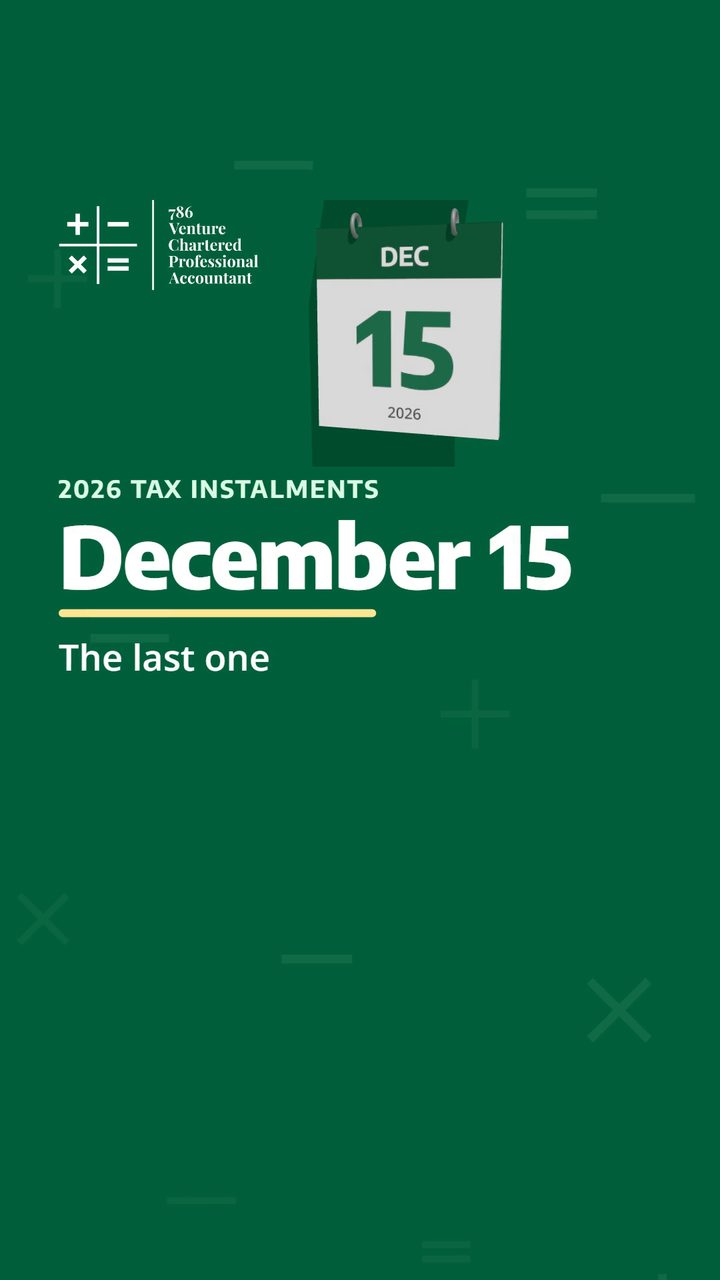
December 15, 2026 is the last of the four personal tax instalment dates for 2026. You have to pay instalments if your net tax owing is more than $3,000 for 2026 and was also more than $3,000 in 2025 or 2024. You can pay the amount on the CRA’s reminder, or work it out from your 2025 return or a 2026 estimate. Corporations pay monthly, or quarterly if they are an eligible small CCPC, and in Alberta the provincial share goes to Alberta. Late or short instalments are charged interest, compounded daily, at 7% a year for the last quarter of 2026.
Who Has to Pay Personal Tax Instalments?
Tax instalments are payments you make during the year toward the tax you would otherwise pay in one lump sum by April 30 of the next year. They usually apply when not enough tax is withheld from your income: for example, if you are self-employed, have rental or investment income, receive certain pension payments, or have income from more than one job.
For 2026, you have to pay instalments if both of these apply:
- your net tax owing for 2026 is more than $3,000, and
- your net tax owing was also more than $3,000 in either 2025 or 2024.
Your net tax owing is worked out for the province or territory where you live on December 31. The threshold is $3,000 everywhere except Quebec, where it is $1,800.
- Reminders come twice a year. The CRA sends instalment reminders (form INNS1) to people who will likely have to pay: in February for the March and June payments, and in August for the September and December payments. You can also see them in your CRA account.
- A reminder is not a bill. If your 2026 net tax owing will be $3,000 or less, you do not have to pay instalments for 2026, even if you received a reminder.
- Farmers and fishers whose main income is from farming or fishing make one payment a year, by December 31.
How Much Should You Pay on December 15?
The CRA gives you three options to calculate your instalments. Each can lower what you pay, and you choose the one that fits your year:
No-calculation option
- The CRA sets the amount from your latest assessed return
- It is shown on your instalment reminders
- Best when your income, deductions and credits stay about the same
Prior-year option
- You work out the amount from your 2025 return
- Best when 2026 will look like 2025 but differ from 2024
- Paid in full and on time, no instalment interest unless the amounts are too low
Current-year option
- You estimate 2026 net tax owing, CPP and voluntary EI
- Best when 2026 will be very different from 2025 and 2024
- If your estimate turns out too low, interest can apply
If you only received an August reminder, it covers September 15 and December 15. You can pay the amount in box 2 of the reminder on each date. Or, with the prior-year or current-year option, add any CPP contributions and voluntary EI premiums payable to your net tax owing, and pay 75% of the total on September 15 and 25% on December 15.
You can also lower or remove instalments by having more tax withheld at source, for example from pension income with Form TD1, or from CPP or OAS through Service Canada. Tax cannot be withheld from self-employment, investment or rental income, or capital gains.
When Are the 2026 Instalment Dates?
| Who pays | 2026 instalment dates |
|---|---|
| Most individuals | March 15, June 15, September 15 and December 15 |
| Farmers and fishers | December 31, one payment |
| Corporation paying monthly, December 31 year-end | The last day of each month, January 31 to December 31 |
| Small CCPC paying quarterly, December 31 year-end | March 31, June 30, September 30 and December 31 |
| Alberta corporate tax, December 31 year-end | The last day of each month, unless exempt |
When a due date falls on a Saturday, Sunday or public holiday, a payment the CRA receives on the next business day is on time. December 15, 2026 is a Tuesday and December 31, 2026 is a Thursday, so neither date moves this year. Any personal tax still owing for 2026 is due by April 30, 2027.

Our packages
Not sure where to start?
- Led by a licensed CPA
- Fixed fees quoted up front
- Bookkeeping, tax and payroll
- Sign up online in minutes
How Do Corporate Tax Instalments Work?
A corporation generally pays its tax in monthly instalments. It does not have to if its tax payable is $3,000 or less for either the current or the previous tax year, and it does not pay instalments in its first tax year after incorporation. Any tax still owing is due on the balance-due day.
Unlike individuals, corporations get no reminder: the CRA does not send instalment reminders to corporations, so each one works out and pays its own. The Corporation Instalment Guide sets out three ways to work out the monthly amount:
- Option 1: one-twelfth of the estimated tax for the current year, each month.
- Option 2: one-twelfth of the previous year’s tax, each month.
- Option 3: one-twelfth of the tax from two years ago in each of the first two months, then the previous year’s tax, less those two payments, spread evenly over the remaining ten months.
Option 1 carries a risk. If the instalments paid are less than the final tax, and option 2 or 3 would have meant higher payments, the CRA charges instalment interest even when every payment was on time. Under option 2 or 3 there is no instalment interest as long as the correct amounts are paid on time, even if a balance is owing at year-end.
With a December 31 year-end, monthly instalments fall on the last day of each month, so the December payment is due December 31, not December 15. For other year-ends, the first payment is due one month less a day from the start of the tax year, and each later one on the same day of the following months. Our T2 deadlines guide covers the balance-due day and the filing deadline.
Can a Small CCPC Pay Quarterly?
Yes, if it meets all of the CRA conditions:
- it is a Canadian-controlled private corporation,
- together with any associated corporations, for the current or the previous tax year it had taxable income of $500,000 or less and taxable capital employed in Canada of $10 million or less, and
- it has a perfect compliance history: in the 12 months before its last instalment was due, it paid its GST/HST, payroll income tax withholdings, CPP and EI on time, and filed all its income tax and GST/HST returns on time.
An eligible small CCPC makes four instalments a year instead of twelve, worked out with the same three options. With a December 31 year-end, they are due March 31, June 30, September 30 and December 31. If it stops qualifying during the year, it pays the next quarterly instalment and then switches to monthly payments.
- Two payments, two places. Alberta has no corporate tax collection agreement with the federal government, so an Alberta corporation pays its Alberta corporate tax and Alberta instalments to Alberta’s Tax and Revenue Administration, not to the CRA.
- Many small CCPCs pay no Alberta instalments. A CCPC is exempt if it claims the Alberta small business deduction and has taxable income of $500,000 or less in the current or the previous tax year, or if its Alberta tax for the year or its first instalment base is $2,000 or less. It then pays its Alberta tax by the end of the third month after its year-end.
- Otherwise, Alberta tax is paid in equal monthly instalments by the last day of each month. Late or short Alberta payments are charged daily compound interest, at 7.0% a year in 2026.
What Happens If You Miss December 15 or Pay Too Little?
Instalment interest. The CRA charges instalment interest on late or insufficient instalments, compounded daily at the prescribed rate, which can change every three months. From October 1 to December 31, 2026, the rate on overdue taxes is 7%. For individuals, it applies when you have to pay instalments, received a 2026 reminder showing an amount, and paid late, paid less or paid nothing. It runs from each due date to your balance-due date, based on whichever calculation option gives the least interest, and you are only charged if it is more than $25.
Instalment penalty. A penalty applies only when your instalment interest for the year is more than $1,000. The CRA takes the higher of $1,000 or 25% of the interest you would have owed with no instalments at all, subtracts it from your actual instalment interest, and charges half of what is left. In the CRA’s own example, $2,500 of instalment interest, against $3,200 if nothing had been paid, gives a penalty of $750.
How to reduce it. If you missed or underpaid an instalment, paying the next one early or paying more than required earns instalment credit interest. That credit is not refunded, but it offsets interest on late or short payments for the same tax year. Corporations follow the same interest, $25, penalty and credit interest rules.
How Do You Pay a December 15 Instalment?
You can pay online, in person or by mail. In person or by mail, use the instalment remittance voucher (form INNS3) from your reminder package so the payment goes to the right account.
- The CRA does not send a receipt right away. Keep proof of payment until it shows in your CRA account, or until your instalment summary (form INNS2) arrives in February.
- Allow 3 business days for an online payment to show in your account, and 10 for a cheque or money order.
How Can We Help With Your Instalments?
We prepare personal and corporate returns for Alberta individuals and owner-managers from our Calgary office, and your onboarding call is a good time to look at which instalment option fits your year.
A T1 personal tax return starts at $200, with $300 for a self-employment schedule (T2125) and $200 for a first rental property (T776). A T2 corporate tax return is included in our Foundation, Growth and Scale plans, and is $800 a year on AI Powered DIY. A T2 on its own, or a NIL or minimal-activity return, is quoted in writing after a free consultation. Fees exclude GST.
Not sure what to pay on December 15? See our packages.
Frequently Asked Questions
When is the December 2026 tax instalment due?
Tuesday, December 15, 2026, for most individuals who have to pay instalments. It is the last of four dates: March 15, June 15, September 15 and December 15. Farmers and fishers pay once, by December 31.
Do I have to pay if I received an instalment reminder?
Not if your 2026 net tax owing will be $3,000 or less ($1,800 or less in Quebec). The CRA sends reminders to people who will likely have to pay, but a reminder alone does not mean you must.
How much do I pay on December 15 if I only got an August reminder?
Either the amount in box 2 of the reminder, or, under the prior-year or current-year option, 25% of the total of your net tax owing, CPP contributions and voluntary EI premiums payable. The other 75% is due September 15.
Does the CRA send instalment reminders to corporations?
No. Corporations work out and pay their own instalments, monthly, or quarterly if they are an eligible small CCPC. In Alberta, the provincial share is paid to Alberta’s Tax and Revenue Administration.
What is the penalty for late or missed instalments?
Instalment interest comes first, compounded daily at the prescribed rate. A penalty applies only if that interest is more than $1,000 for the year: half of the amount by which it exceeds $1,000 or 25% of the interest with no instalments, whichever is higher.
Reviewed on 21 October 2026. Instalment thresholds, due dates, interest rates and penalty rules in this article are from the Canada Revenue Agency and the Government of Alberta, linked beside each fact and listed below.
T1 Personal Tax
Personal tax returns from $200, with self-employment and rental schedules at fixed fees
T2 Corporate Tax
Every Canadian corporation must file a T2 within six months of fiscal year-end, active or inactive
Sources
- Canada Revenue Agency, Required tax instalments for individuals (page dated 2026-01-20, checked 20 October 2026)
- Canada Revenue Agency, Required tax instalments for individuals: who has to pay (page dated 2026-01-20, checked 20 October 2026)
- Canada Revenue Agency, Required tax instalments for individuals: options to calculate (page dated 2026-01-20, checked 20 October 2026)
- Canada Revenue Agency, Required tax instalments for individuals: payment due dates (page dated 2026-01-20, checked 20 October 2026)
- Canada Revenue Agency, Required tax instalments for individuals: how to pay (page dated 2026-01-20, checked 20 October 2026)
- Canada Revenue Agency, Required tax instalments for individuals: interest and penalty charges (page dated 2026-01-20, checked 20 October 2026)
- Canada Revenue Agency, Prescribed interest rates for the fourth calendar quarter of 2026 (page dated 2026-08-28, checked 20 October 2026)
- Canada Revenue Agency, Corporate income tax payments: who has to pay in instalments (page dated 2025-12-31, checked 20 October 2026)
- Canada Revenue Agency, Corporate income tax payments: due dates for payments (page dated 2026-01-21, checked 20 October 2026)
- Canada Revenue Agency, Calculating corporate tax instalments (page dated 2026-05-05, checked 20 October 2026)
- Canada Revenue Agency, Corporation Instalment Guide 2025 (T7B Corp) (page dated 2025-02-14, checked 20 October 2026)
- Government of Alberta, Corporate income tax (remittance due dates and instalment exemptions) (no page date, checked 20 October 2026)
- Government of Alberta, Tax, levy, and prescribed interest rates (TRA prescribed interest rates) (no page date, checked 20 October 2026)