

What a small business owner in Canada can deduct for a cell phone and home internet: the business-use percentage and how to work it out, a business line versus your personal phone, the phone itself, internet shared with your family, a corporation paying for the owner’s phone, the GST/HST and the records to keep, with every rule linked to the Canada Revenue Agency.
You can deduct the business part of your cell phone plan and your home internet. Self-employed people deduct the percentage of cell phone airtime they use to earn business income, and the full basic monthly rate of a separate phone used only for business, but not the basic monthly rate of a home phone. The phone itself is not an expense: you claim capital cost allowance (CCA) on the business part. Home internet you share with your family is deductible for the business part on a reasonable basis, and it does not depend on the home office rules. If your corporation pays for your phone, a phone it owns and requires you to use for work is not a taxable benefit, and neither is a reasonable fixed-cost plan, but a cash allowance always is. GST/HST registrants claim input tax credits on the business part of the monthly bills, and all of the GST/HST on a phone used more than 50% in the business.
What Phone and Internet Costs Can You Deduct?
The CRA’s page for line 9220 of Form T2125 says you can deduct telephone and utilities expenses you incurred to earn income. For phones, the same page sets four rules:
- A separate business line: if you have a separate telephone for business calls only, you can deduct its basic monthly rate.
- Your home phone: you cannot deduct its basic monthly rate, but you can deduct the long distance calls you made on it for your business.
- Your cell phone: you can deduct the percentage of airtime expenses for a cell phone you use to earn your business income.
- Home office utilities: utilities related to a workspace in your home are claimed as business-use-of-home expenses instead.
The CRA’s page on other business expenses adds two more. If you lease a cell phone or computer, you deduct the percentage of the lease costs that reasonably relates to earning your business income. If you buy one, you cannot deduct the cost; you deduct the business part of the capital cost allowance and of any interest on money you borrowed to buy it.
The CRA’s folio on business use of home expenses (S4-F2-C2) says telephone and internet service may relate to your business but do not relate to the work space, so the home office conditions do not apply to them. They are deducted as a regular business expense, and when the service at your home is used for business and personal purposes, only the business part is deductible. The space itself is a separate claim with its own tests; see our guide to home office expenses.
Phone and Internet Costs at a Glance
This table puts the CRA’s rules for a self-employed person side by side. The GST/HST rows apply only if you are registered for the GST/HST.
| Cost | What a sole proprietor can claim |
|---|---|
| Cell phone plan you use for business and personal calls | The business part of the airtime |
| Basic monthly rate of a separate business-only phone line | 100% |
| Basic monthly rate of your home phone | Not deductible |
| Business long distance calls made on your home phone | 100% of those calls |
| Home internet you share with your family | The business part, on a reasonable basis |
| Buying a cell phone, tablet or computer | CCA on the business part, not an expense |
| Leasing a cell phone or computer | The business part of the lease costs |
| Interest on a loan to buy the phone | The business part |
| GST/HST on the monthly bills (registrants) | Input tax credit for the business part, or all of it at 90% business use or more |
| GST/HST on the phone itself (registrants) | All of it if used more than 50% in the business, none at 50% or less |
The table is for sole proprietors filing Form T2125. A corporation deducts its own phone and internet costs, and the questions for an owner who works for the corporation are covered further down.

Our packages
Not sure where to start?
- Led by a licensed CPA
- Fixed fees quoted up front
- Bookkeeping, tax and payroll
- Sign up online in minutes
A Business Line or Your Personal Phone?
Most owners use one cell phone for everything and deduct the business part of the plan. A second line used only for business is simpler to support, because its whole basic monthly rate is deductible with no percentage. The family landline is the one the CRA treats differently.
A phone used only for business
- Basic monthly rate: 100%
- All business calls and charges on it
- Keep family use off this line
One phone for work and home
- The business part of the airtime
- Work out the percentage and keep the bills
- The phone itself through CCA
The family landline
- Basic monthly rate: not deductible
- Business long distance calls: deductible
- Mark the business calls on the bill
How Do You Work Out the Business-Use Percentage?
The CRA does not set one formula for phones. Its folio says to use a reasonable basis to work out the part of the usage that belongs to the business, and its GST/HST page on the percentage of use in commercial activities says the method has to be fair and reasonable and used consistently throughout the year.
What we suggest to our clients, as a practical way to meet that standard:
- Pick a basis that fits how you use the service: minutes or calls from an itemized bill for a phone, or the hours you work online for internet.
- Look at more than one month. Take a few typical months across the year, not your busiest one, and average them.
- Write down how you did it, with the months you used and the result, and keep it with the bills.
- Use the same percentage for your income tax claim and your GST/HST input tax credits, and change it when the way you use the phone changes.
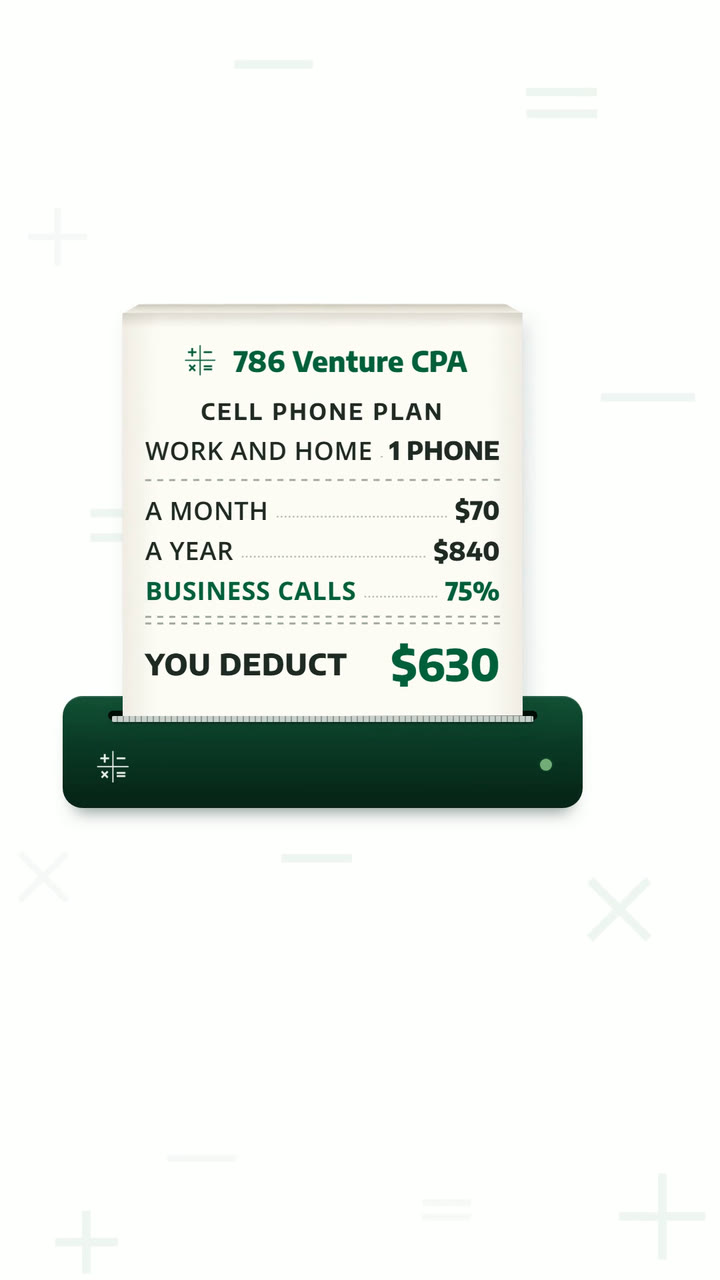
- Your cell phone plan is $70 a month, or $840 a year before GST.
- Your itemized bills for three typical months show about 75% business calls.
- Business part: $840 × 75% = $630, deducted on line 9220.
- GST in Alberta is 5%: $840 × 5% = $42 of GST, and the input tax credit is $42 × 75% = $31.50.
The numbers are our example; the method is the CRA’s.
How Do You Claim the Phone Itself?
A cell phone, tablet or computer you buy lasts more than a year, so the CRA does not let you deduct the price. You claim capital cost allowance (CCA), a yearly deduction at the rate of the property’s class, and only the part that relates to your business.
The CRA’s classes of depreciable property page puts general-purpose electronic data processing equipment and its systems software in Class 50 at 55%, and electronic communications equipment, such as fax machines and electronic telephone equipment, in Class 8 at 20%. The CRA’s pages do not name smartphones. A smartphone you use for your business goes in Class 50 at 55%, and that is the class we use when we prepare your return.
For Class 50, the same page says that under proposed changes, new additions of Class 50 property are eligible for an enhanced first-year deduction of 100%. This applies to property acquired after April 15, 2024, and that becomes available for use before 2027. Property that will become available for use in 2027 will continue to benefit from the accelerated investment incentive or the reaccelerated investment incentive. We last checked this wording on the CRA’s page on 3 November 2026. For how the first year works in other classes, see our guide to CCA and the half-year rule. If you lease the phone instead, you deduct the business part of the lease costs and claim no CCA.
Can You Deduct Home Internet You Share With Your Family?
Yes, the business part. The folio says that when telephone and internet service at your home is used for both business and personal purposes, only the business portion of the expense is deductible, on a reasonable basis of proration. You do not need a home office that meets the CRA’s tests to claim it, because internet service is not a cost of the work space.
A household plan is usually used by everyone at home, so the business part is often lower than for a phone you carry for work. Use the same approach as for the phone: a basis that fits, a few typical months, and a note of how you got the number. If your internet comes in a bundle with television or a home phone, take the internet part of the bill, not the whole bundle.
What If Your Corporation Pays for Your Phone?
When you are incorporated and on the payroll, the corporation pays the bills and deducts them as its own business costs, with CCA on the phones it buys. The question then is your side as an employee: is the phone or plan a taxable benefit? The CRA’s page on cell phone and internet services and its Employers’ Guide T4130 give these rules:
- A phone the corporation owns and requires you to use for your work is not a taxable benefit.
- A plan the corporation provides or reimburses is not a taxable benefit if you are required to use it for work, it has a reasonable fixed cost, and your personal use does not add charges above the plan cost. Extra charges caused by personal use are taxable unless you pay them back. The corporation must be ready to show why the plan cost is reasonable for your work.
- Reimbursing you for a phone you bought yourself is a taxable benefit, even if you use it, lose it or damage it at work.
- Home internet the corporation provides or reimburses: the business part is not taxable; the personal part is.
- An allowance, a set amount for a phone or internet with no accounting for it, is always taxable.
A taxable benefit is the fair market value of the personal use, minus anything you pay back, and it goes on your T4 slip. If the corporation is a GST/HST registrant, the Employers’ Guide says it is generally considered to have collected GST/HST on a taxable benefit and has to remit it; that does not apply to an allowance.
Owners who are not on the payroll. These rules are written for employees. The Employers’ Guide says people are generally taxable on benefits they receive from a corporation of which they are a shareholder, so if the corporation pays for the phone of an owner who takes only dividends, talk to us about how to treat it before year end.
- An employee owns their phone and uses it 60% of the time for personal calls. The plan is $80 a month with extra features the job does not need, so the cost is not reasonable.
- The employer reimburses the whole plan: $80 × 12 = $960 a year.
- Taxable benefit: $960 × 60% personal use = $576 on the T4 slip.
If the plan had been a reasonable fixed-cost plan with no extra personal charges, the reimbursement would not have been a taxable benefit.
Can You Claim the GST/HST on Your Phone and Internet?
Yes, if you are a GST/HST registrant, and the rule is different for the bills and for the phone itself.
Monthly bills. The CRA’s page on the percentage of use in commercial activities says you can generally claim input tax credits (ITCs) only for the part of the GST/HST that relates to your use in your commercial activities. Guide RC4022 adds that if 90% or more of an operating expense is used in your commercial activities, you claim 100% of the GST/HST on it.
The phone itself. A phone, tablet or computer is capital personal property, and RC4022’s primary use rule applies: if you use it more than 50% in your commercial activities, you claim all of the GST/HST; at 50% or less, you claim none. The CRA’s own example is a $2,000 computer used 60% in the business and 40% personally, which gets an ITC for all of the GST/HST paid. If the business use later drops to 50% or less, the CRA treats the property as sold and you pay back part of the tax; if it rises above 50%, you can then claim part of it.
What Records Should You Keep?
Keep what shows the cost and the business part. Records are normally kept for six years from the end of the tax year they relate to; see how long to keep business records.
- Bills: the monthly bill for each phone and internet plan, itemized where your provider offers it.
- Your percentage: the months you looked at, how you counted and the result.
- Devices: the receipt or lease for each phone, tablet or computer, and the date you started using it.
- Corporation: who has each phone, a note that the job requires it, why the plan cost is reasonable, and any amounts the employee paid back.
- GST/HST: the GST/HST on each bill and receipt, and the percentage you used for the input tax credit.
How Can We Help With Phone and Internet Expenses?
For sole proprietors, we prepare your personal return with the business statement (Form T2125), including the business part of your phone and internet and the CCA on your devices. For incorporated owners, we record phone and internet costs and the GST/HST input tax credits in your books, and through payroll we report any taxable benefit on your T4 slip, then prepare the corporation’s T2 return. Fees are fixed and quoted up front.
If you want your phone and internet claims set up the right way before your year end, see our packages.
Frequently Asked Questions
Can I deduct my whole cell phone bill if I use the phone for work?
Only the business part, unless the phone is used only for business. The CRA lets you deduct the percentage of airtime you use to earn business income. If you have a separate phone used only for business calls, you can deduct its basic monthly rate in full.
Can I write off the cost of a new phone in the year I buy it?
Not as an expense. A phone you buy is depreciable property, so you claim capital cost allowance on the business part. A smartphone you use for your business goes in Class 50 at 55%. Under proposed changes, the CRA says new additions of Class 50 property acquired after April 15, 2024, and that become available for use before 2027, are eligible for an enhanced first-year deduction of 100%. If you lease the phone, you deduct the business part of the lease costs.
Do I need a home office to deduct my home internet?
No. The CRA says telephone and internet service may relate to your business but not to the work space, so the home office conditions do not apply. You deduct the business part, worked out on a reasonable basis.
Is a phone my corporation pays for a taxable benefit?
Not if the corporation owns the phone and requires you to use it for work. A plan it pays for is not taxable if you need it for work, it has a reasonable fixed cost and your personal use adds no extra charges. A cash allowance for a phone or internet is always taxable.
Can I claim the GST/HST on my phone and internet?
Yes, if you are a GST/HST registrant. On the monthly bills you claim the part used in your business, or all of it if the business use is 90% or more. On the phone itself you claim all of the GST/HST if you use it more than 50% in the business, and none at 50% or less.
Reviewed on 2 November 2026. The phone and internet rules, capital cost allowance classes, taxable benefit rules, GST/HST rules and examples in this article are from the Canada Revenue Agency, linked beside each fact and listed below.
Bookkeeping
Monthly bookkeeping with your phone, internet and GST/HST input tax credits recorded at the business part
T1 Personal Tax
Personal tax returns, including the business statement with your phone, internet and CCA for self-employed Canadians
T2 Corporate Tax
Corporate tax returns for Canadian corporations, with phones, plans and benefits handled the right way
Sources
- Canada Revenue Agency, Line 9220, Utilities (telephone) (page dated 2026-08-31, checked 2 November 2026)
- Canada Revenue Agency, Other business expenses (computer and other equipment leasing costs) (page dated 2026-08-31, checked 2 November 2026)
- Canada Revenue Agency, Business-use-of-home expenses (page dated 2026-08-31, checked 2 November 2026)
- Canada Revenue Agency, Income Tax Folio S4-F2-C2, Business Use of Home Expenses (paragraphs 2.32 and 2.33) (page dated 2018-04-17, checked 2 November 2026)
- Canada Revenue Agency, Classes of depreciable property (Class 8 and Class 50) (page dated 2026-08-31, checked 2 November 2026)
- Canada Revenue Agency, Cell phone and internet services (taxable benefits) (page dated 2022-10-05, checked 2 November 2026)
- Canada Revenue Agency, Employers’ Guide T4130, Taxable Benefits and Allowances (page dated 2026-08-17, checked 2 November 2026)
- Canada Revenue Agency, Guide RC4022, General Information for GST/HST Registrants (page dated 2026-01-07, checked 2 November 2026)
- Canada Revenue Agency, Calculate input tax credits, Percentage of use in commercial activities (page dated 2025-06-16, checked 2 November 2026)


